Allyra.ai · Outcome-first initiation · Unified workspace · Agentic search · 2026 · 5 min read
4 tools → 1 workspace: starting AI work from the outcome, not the agent
People shouldn't need to understand an agent catalogue to get work done. Work now starts from the outcome, runs in one workspace that fills a living deliverable — and agentic search turns a query into a visible, cited plan.
In 60 seconds
- Problem
- People shouldn't need to understand an agent catalogue to get work done.
- What I did
- Designed how work starts from the outcome: one workspace that fills a living deliverable, and agentic search that turns a query into a visible, cited plan.
- Result
- 4 → 1 workflows in one workspace · ~40% fewer steps to start work (est.)
- My role
- Product Lead, Pansophic Technologies
Context
People shouldn't need to understand agent taxonomies before getting work done.
A directory of specialised agents pushes the vendor's internal architecture onto the user. Customers don't want to administer AI tools; they want verified deliverables.
Moving between isolated agents and copying unstructured chat answers into spreadsheets, documents and slide tools causes fatigue and breaks flow.
After the first enterprise release, pilots showed a clear pattern: knowledge workers don't need another chatbot that speaks in confident paragraphs. Real work needs deterministic, verifiable outcomes.
We didn't set out to make AI sound smarter. We set out to make AI more verifiable, collaborative and actionable.
My role
What I owned
Designed how work starts from the outcome: one workspace that fills a living deliverable, and agentic search that turns a query into a visible, cited plan.
- Human–AI interaction design
- Enterprise workflow design
- Product strategy & definition
Key decisions
6 decisions that shaped it
Start with the outcome. Not the agent.
- Observation
- People shouldn't need to understand agent taxonomies before getting work done. A directory of specialised agents pushes the vendor's internal architecture onto the user. Customers don't want to administer AI tools; they want verified deliverables.
- Decision
- Turn context, sub-tasks and agent routing into an automated flow. Shift initiation from bot selection to expressing the end goal. Allyra captures enterprise context, works out dependencies and spins up the agents it needs — without asking the user to decide.
- Result
- ~40% fewer steps to start complex enterprise work (est.)
AI capabilities shouldn't feel disconnected
- Observation
- Fragmented workflows break focus and create manual translation work. Moving between isolated agents and copying unstructured chat answers into spreadsheets, documents and slide tools causes fatigue and breaks flow.
- Decision
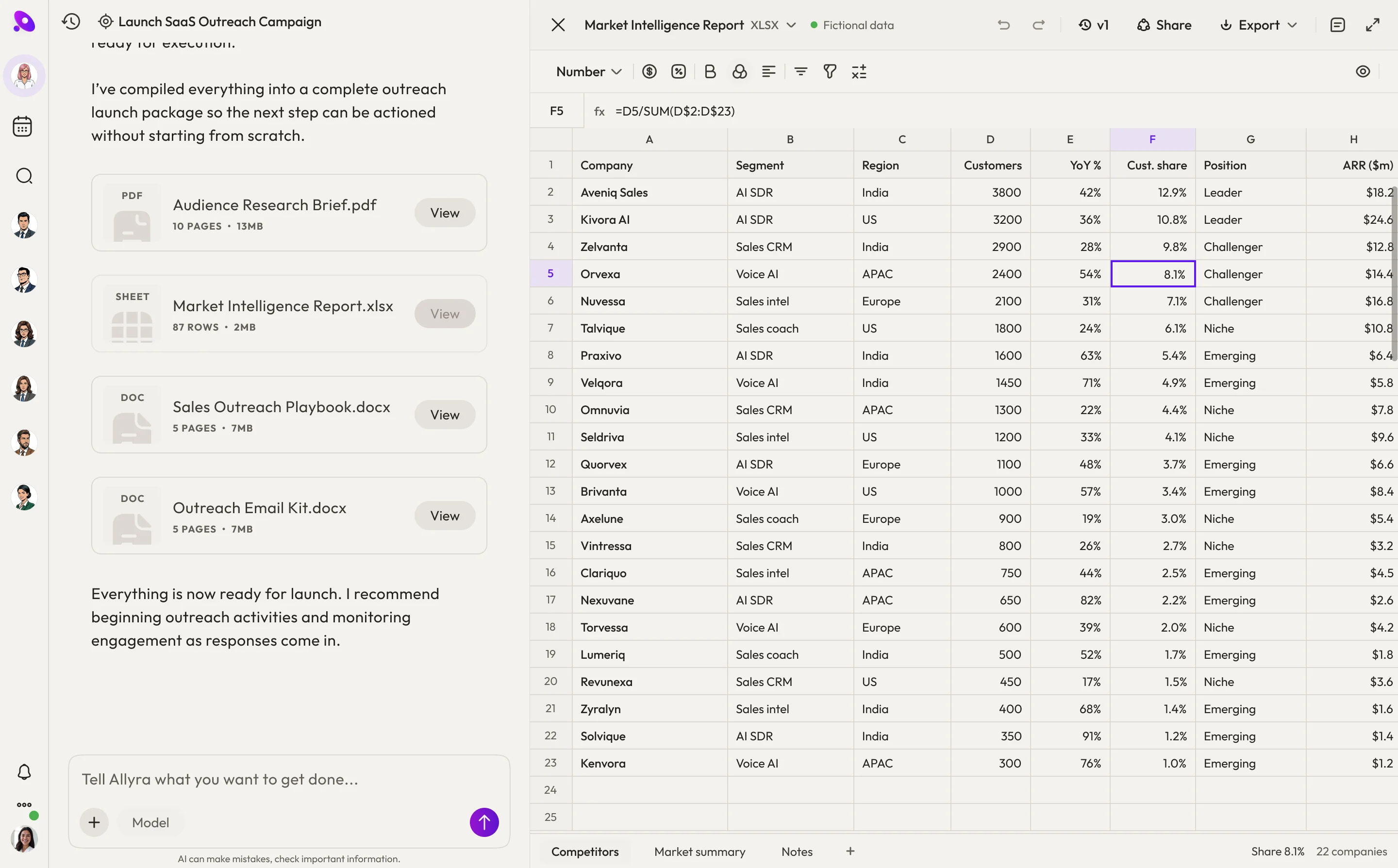
- Anchor multi-agent execution to a living deliverable canvas. Agent activity coordinates on the left while it structures and fills an exportable deliverable on the right, in real time.
- Result
- 4 → 1 disconnected workflows brought into one continuous experience
From search query to multi-agent execution
- Observation
- Single-turn search makes people chain queries and paste findings between windows.
- Decision
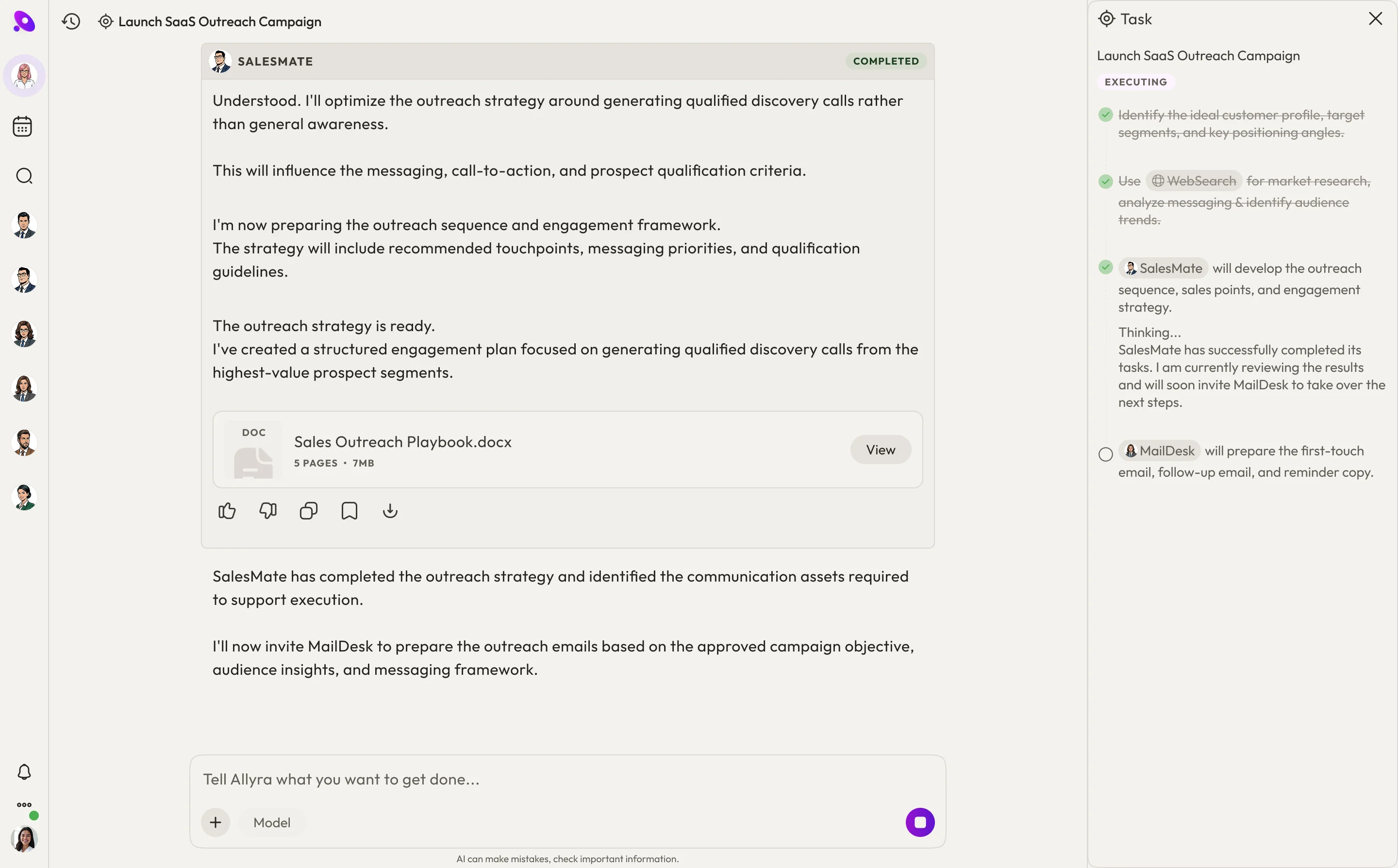
- Goals break into specialised agents (e.g. JD drafting, screening, scheduling) with visible dependencies.
- Result
- People see the whole plan before execution starts; ambiguous goals become repeatable workflows.
Transparent, defensible responses
- Observation
- Enterprise stakeholders reject claims they can't audit; one ungrounded statement breaks trust.
- Decision
- Connector-level citations: every assertion links to its source file, timestamp and the viewer's permissions.
- Result
- One-click verification before acting on mission-critical decisions.
Structured, contextual outputs
- Observation
- Chat streams produce paragraphs that can't be edited, filtered or handed off.
- Decision
- Results render as interactive tables, status boards and action components.
- Result
- Living deliverables: people act inside the result instead of copying it elsewhere.
Human-in-the-loop decisions
- Observation
- When AI makes assumptions in silence, small misreadings compound into large errors.
- Decision
- Steering gates: high-impact operations pause so people can adjust parameters, inspect citations or re-route.
- Result
- Safe speed — AI does the heavy lifting while experts keep accountability.
In the product
How a goal starts
A single request in Allyra, as designed in portal v1.5: no agent picking, no tool switching.
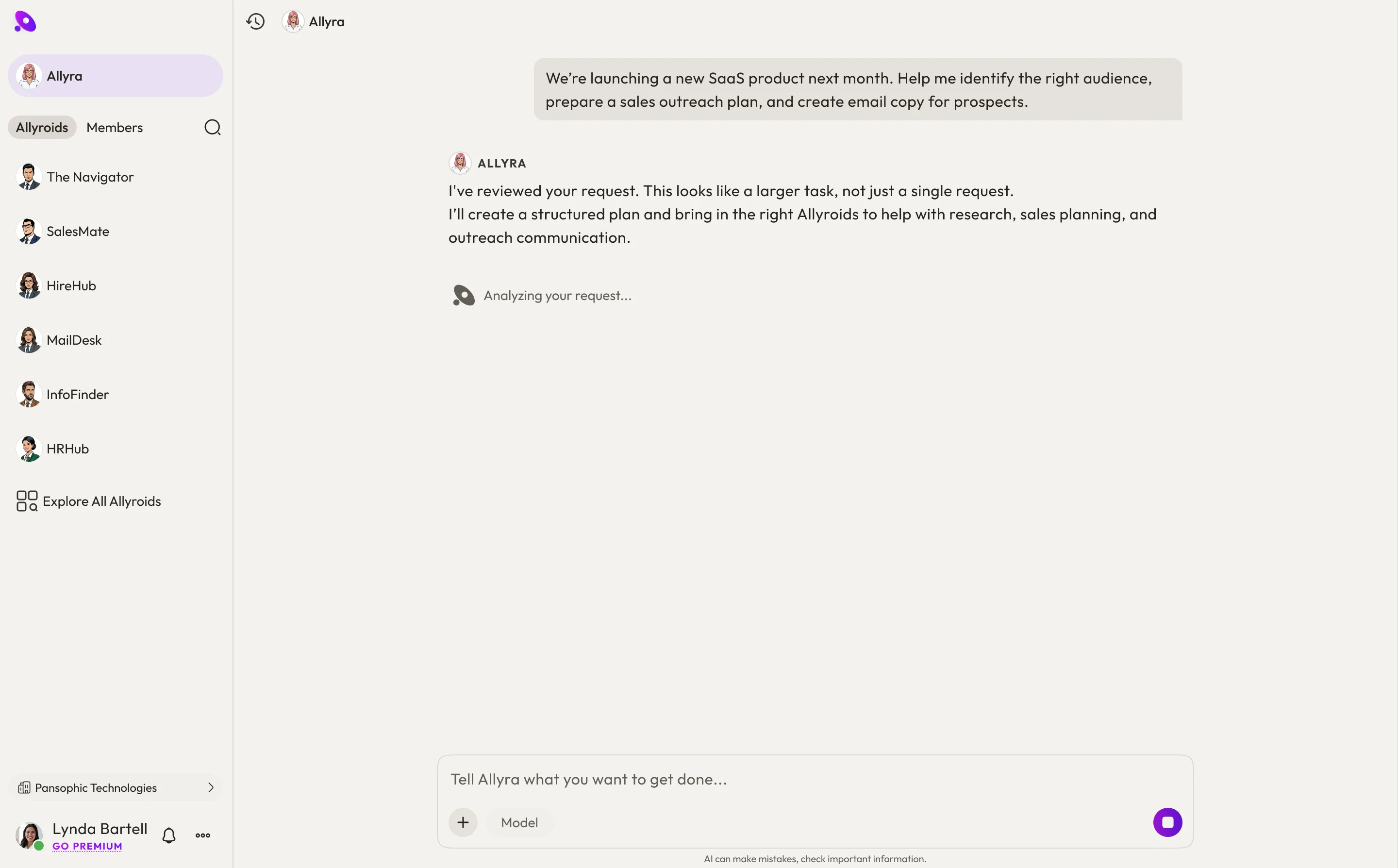
1 · Ask — the person describes the outcome; Allyra recognises a goal, not a one-off question. 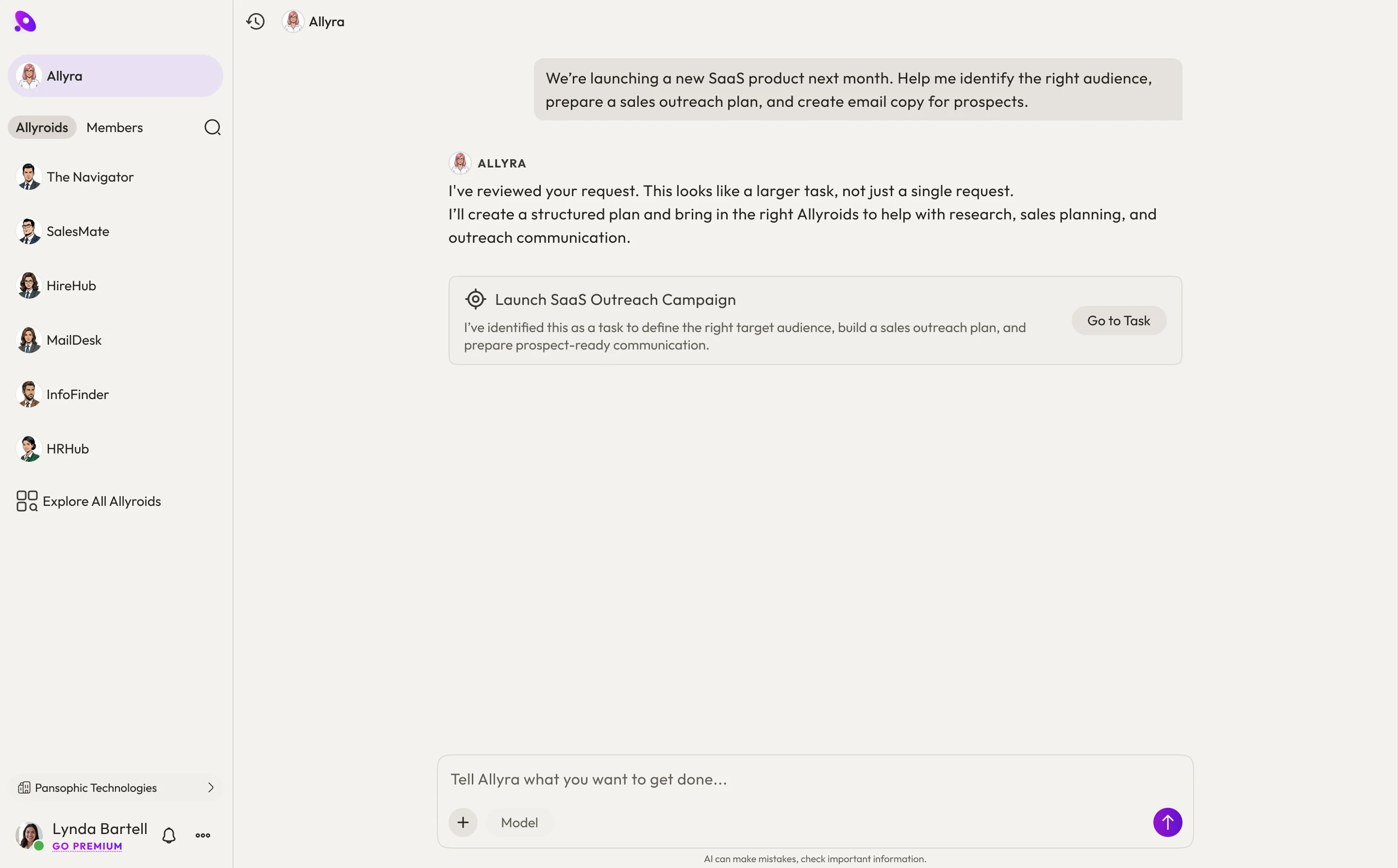
2 · Plan — a goal card names the goal and the plan before any agent starts.
Result
What changed
- ~40%fewer steps to start complex enterprise work (est.)Removing the agent catalogue and scoping workspace context automatically takes people straight from a goal to a plan.
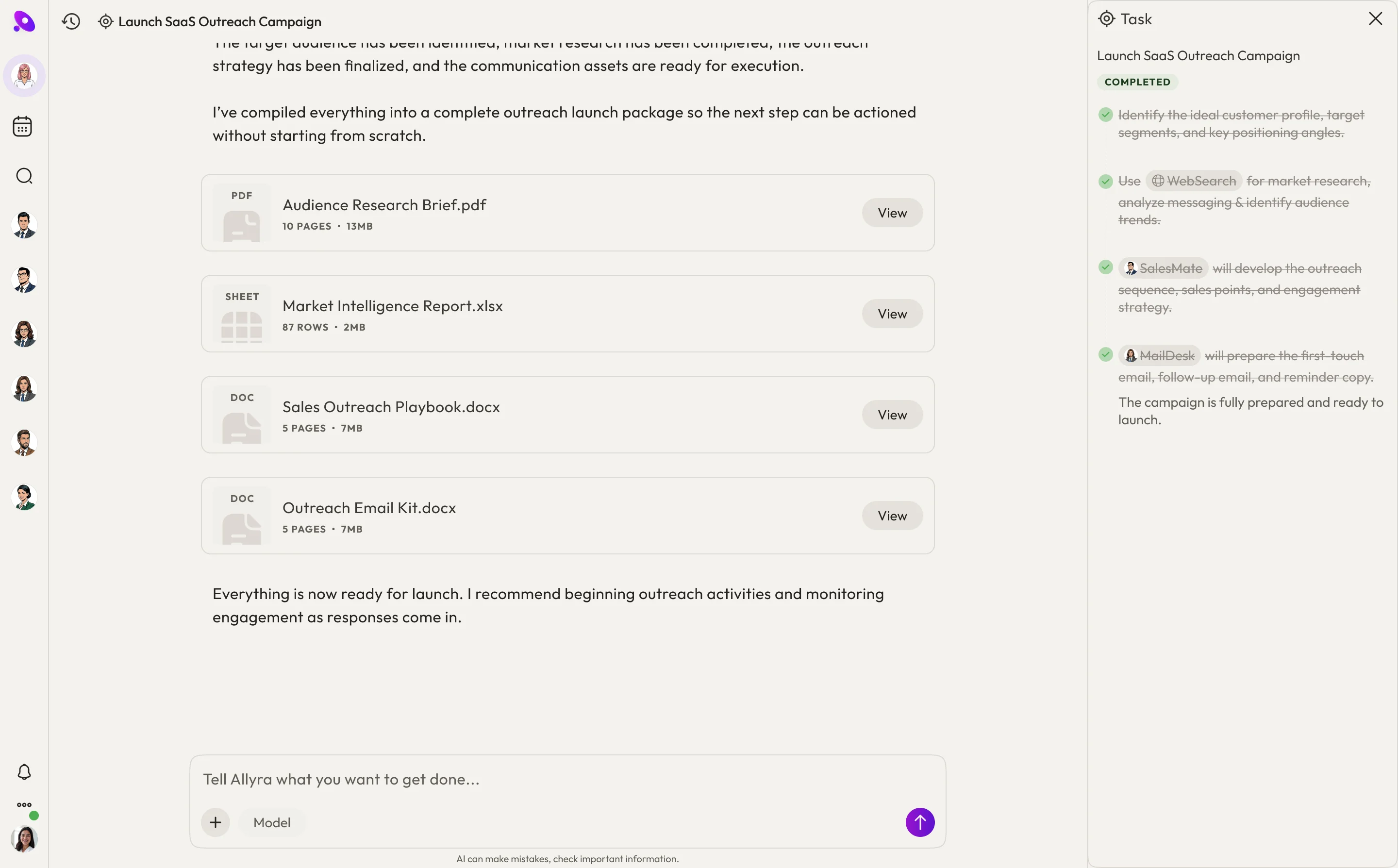
- 4 → 1disconnected workflows brought into one continuous experienceResearch extraction, data analysis, copy synthesis and document assembly now happen in one canvas, with one-click export to native tools.
What I learned
From black-box autonomy to verifiable agency
Enterprise AI won't be won by the biggest model. It will be won by whoever designs the most reliable, transparent collaboration between experts and intelligent systems — decomposing intent, enforcing provenance and keeping people in control.