Allyra.ai · Enterprise AI platform · 0→1 · 5 min read
From pilot to 15+ organisations: scaling Allyra into an enterprise AI platform
Leading product and UX for Allyra.ai as it grew from a tool for building AI agents into a platform 15+ organisations use to run work with 19+ agents.
In 60 seconds
- Problem
- AI wasn't struggling to generate answers. It was struggling to operate inside real workflows.
- What I did
- Led product and UX from agent builder to enterprise platform, turning customer and market gaps into its 19+ AI agents.
- Result
- 50+ pilots → 15+ organisations onboarded (~30%) and 1,000+ users by Jun 2026, across 19+ AI agents I defined
- My role
- Product Lead — promoted from UXD Head (Jan 2025)
Context
AI wasn't struggling to generate answers. It was struggling to operate inside real workflows.
In late 2024 the industry was obsessed with models. The real challenge wasn't access to AI — it was turning AI into something businesses could actually use.
Building a useful agent meant prompt engineering, knowledge systems, APIs, integrations and continuous maintenance. The people who understood the business problems usually couldn't build the AI themselves. That gap became the opportunity.
My first bet: specialised, domain-specific agents would deliver more reliable outcomes than one general model — so the job was to make agent creation accessible to non-technical people.
My role
What I owned
My role went beyond UX. I worked where market signals, business strategy and product execution meet — and translated emerging AI capabilities into products people could actually use.
- Product strategy & definition
- Roadmap & feature prioritisation
- Human–AI interaction design
- Enterprise workflow design
- Stakeholder alignment
- Design team leadership
- 3 + 2designers and business analysts led
- 1 → 2–3features per designer per weekFigma paired with coded prototypes and AI-assisted workflows
Promoted · Jan 2025. Started as UXD Head at Vrozart Dackson (Jun 2024). When its core leadership founded Pansophic Technologies in Jan 2025, I joined as a founding core-team member and was promoted to Product Lead, continuing to own Allyra.
How it evolved
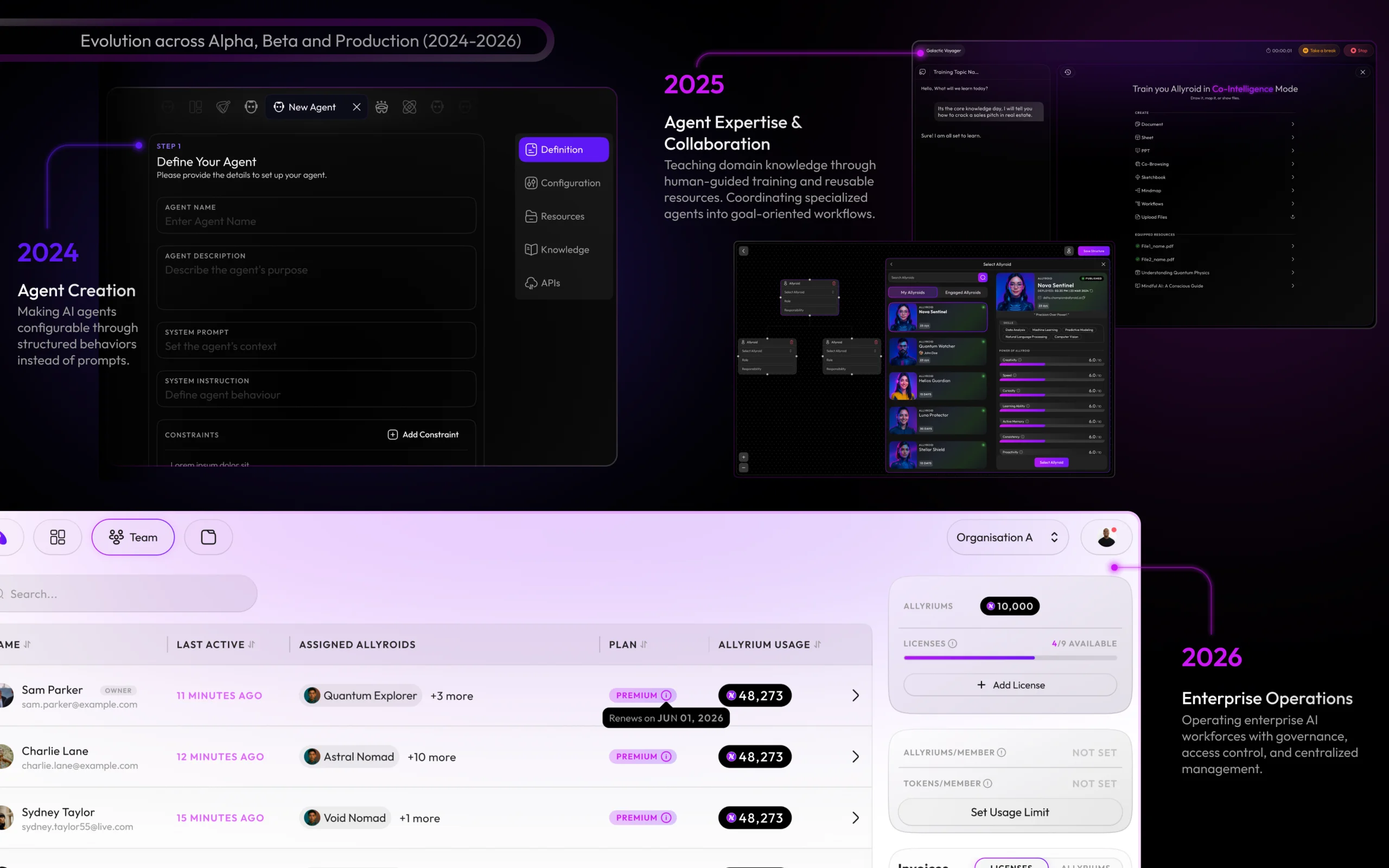
Alpha to production in 3 steps
- 2024 · Alpha
Agent creation
Make AI agents configurable through structured behaviours instead of hand-written prompts.
- 2025 · Beta
Expertise & collaboration
Teach agents domain knowledge through expert-guided training; let specialised agents work together toward one goal.
- 2026 · Production
Enterprise AI operations
An operating layer for control, spend and trust: one workspace where people delegate outcomes and stay in charge.
Key product decisions
Four decisions that shaped the platform
One agent isn't enough
- Observation
- Real business workflows rarely belong to a single specialist.
- Decision
- Design for multi-agent collaboration.
- Result
- Specialised agents work together toward shared goals.
Knowledge ≠ expertise
- Observation
- Agents could retrieve information but hedged — offering several possible answers instead of taking a professional position.
- Decision
- Add a training layer so subject-matter experts can shape agent behaviour.
- Result
- Agents moved from information retrievers to domain-specific assistants.
Discoverability matters
- Observation
- Creating and training agents only mattered if people could find and use them.
- Decision
- Introduce an agent marketplace.
- Result
- A full lifecycle: create → train → publish → use.
People don't want agents
- Observation
- Enterprise conversations shifted from “how do I build agents?” to “how do I control them, manage spend and trust them?”
- Decision
- Pivot from agent builder to an enterprise operating layer.
- Result
- The Portal — a workspace focused on outcomes, governance and oversight.
How it flows
Hiring workflow
- 01JD creation
- 02Resume screening
- 03Interview scheduling
- 04AI interview
- 05Evaluation
- 06Onboarding
One of the strongest examples of operational AI: instead of isolated tools, one connected workflow.
Presentation workflow — a deliberate trade-off
- 01Brief & settings
- 02Outline review
- 03Template
- 04Generate slides
- 05Edit & refine
- 06Present
Automation without control creates poor outcomes. The system structures and generates; people stay responsible for quality and direction.
Two of the 19+ agents I defined, each built around a gap customers raised.
Evidence
What shipped
From agent builder to an operating layer: the surfaces enterprise adoption actually needed.
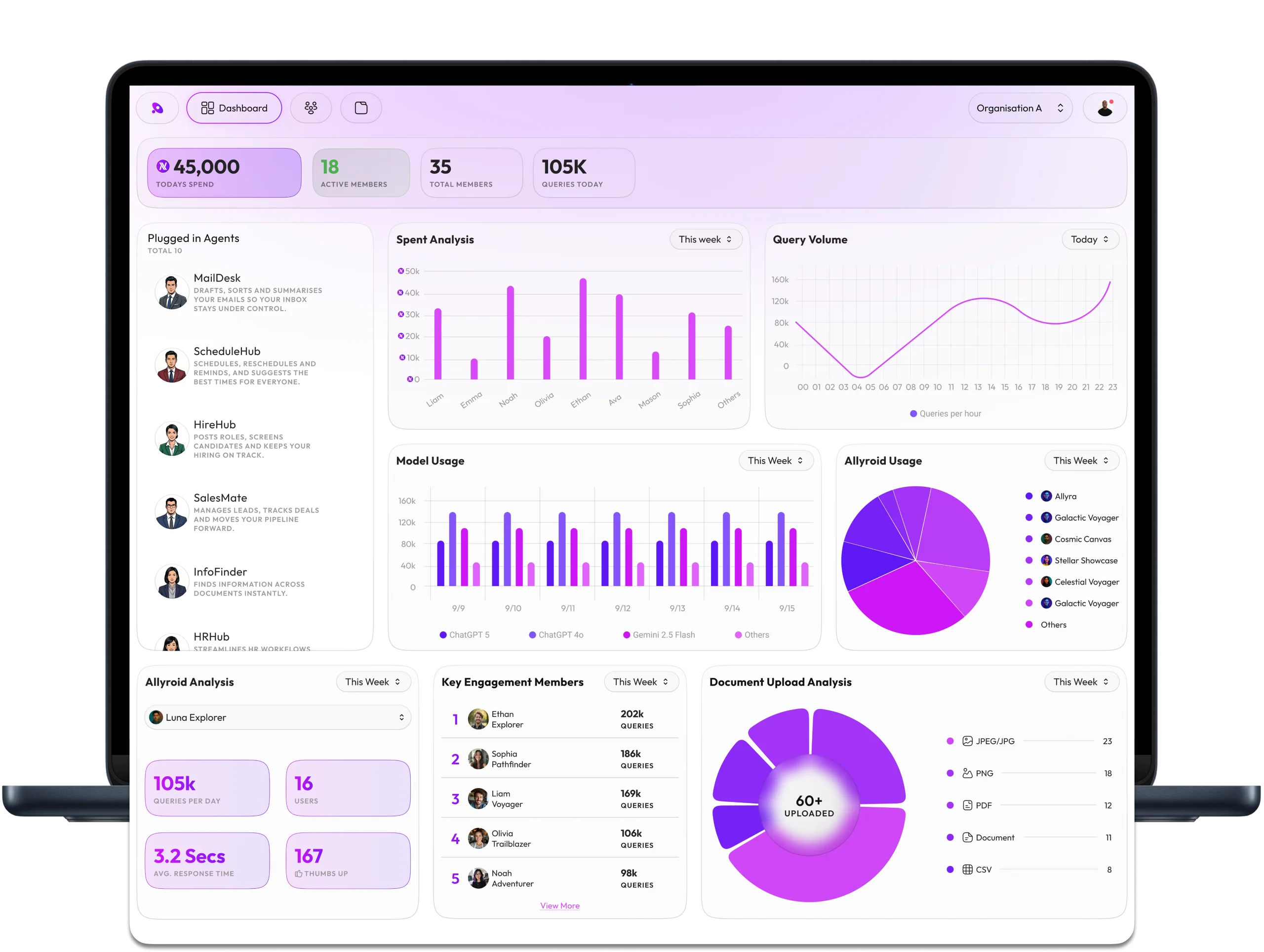
The Portal: the gateway into the ecosystem — built around operational outcomes, not agent creation. 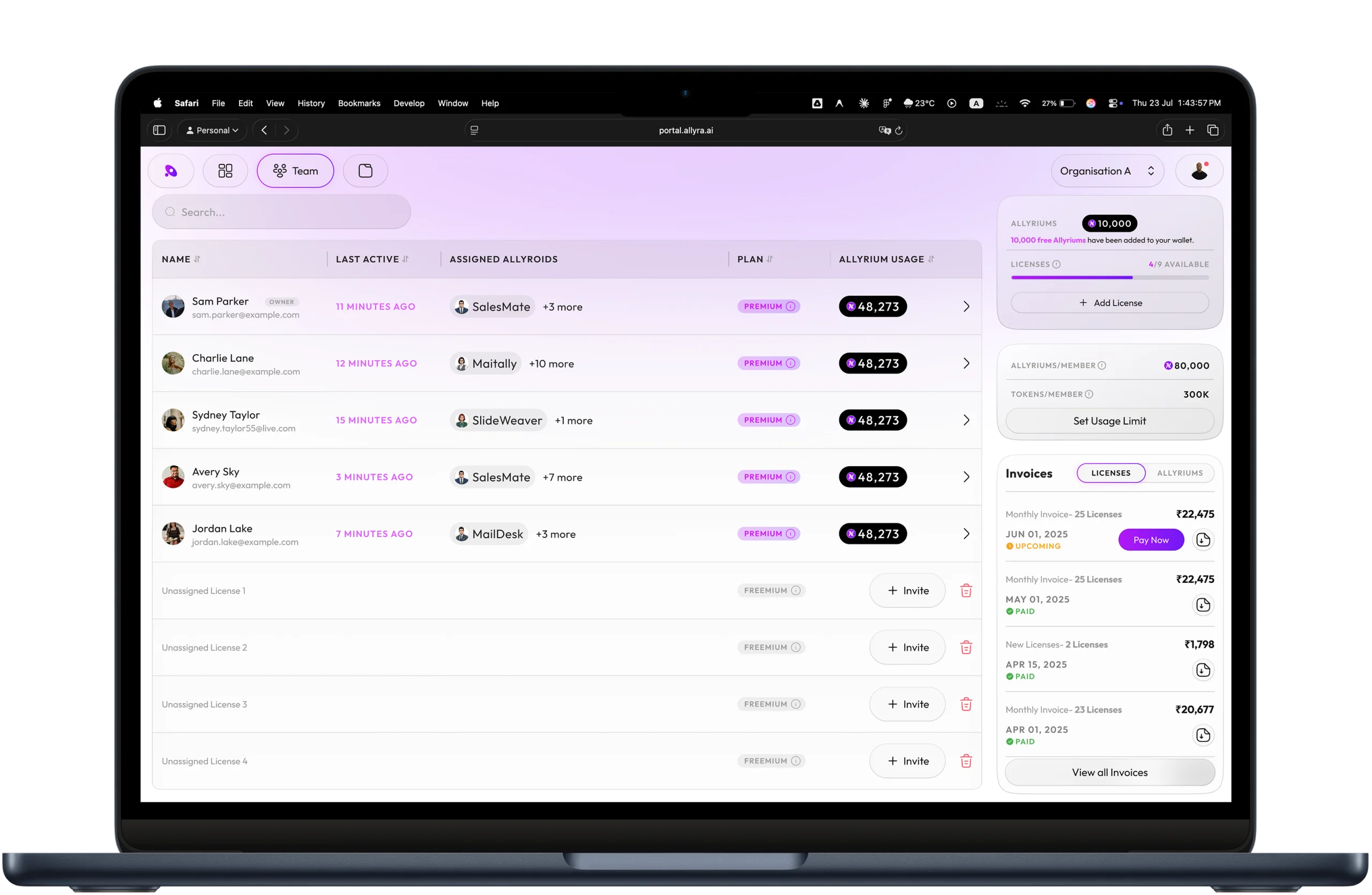
Governance: what enterprise adoption required: budget controls, usage monitoring, access management and licensing. 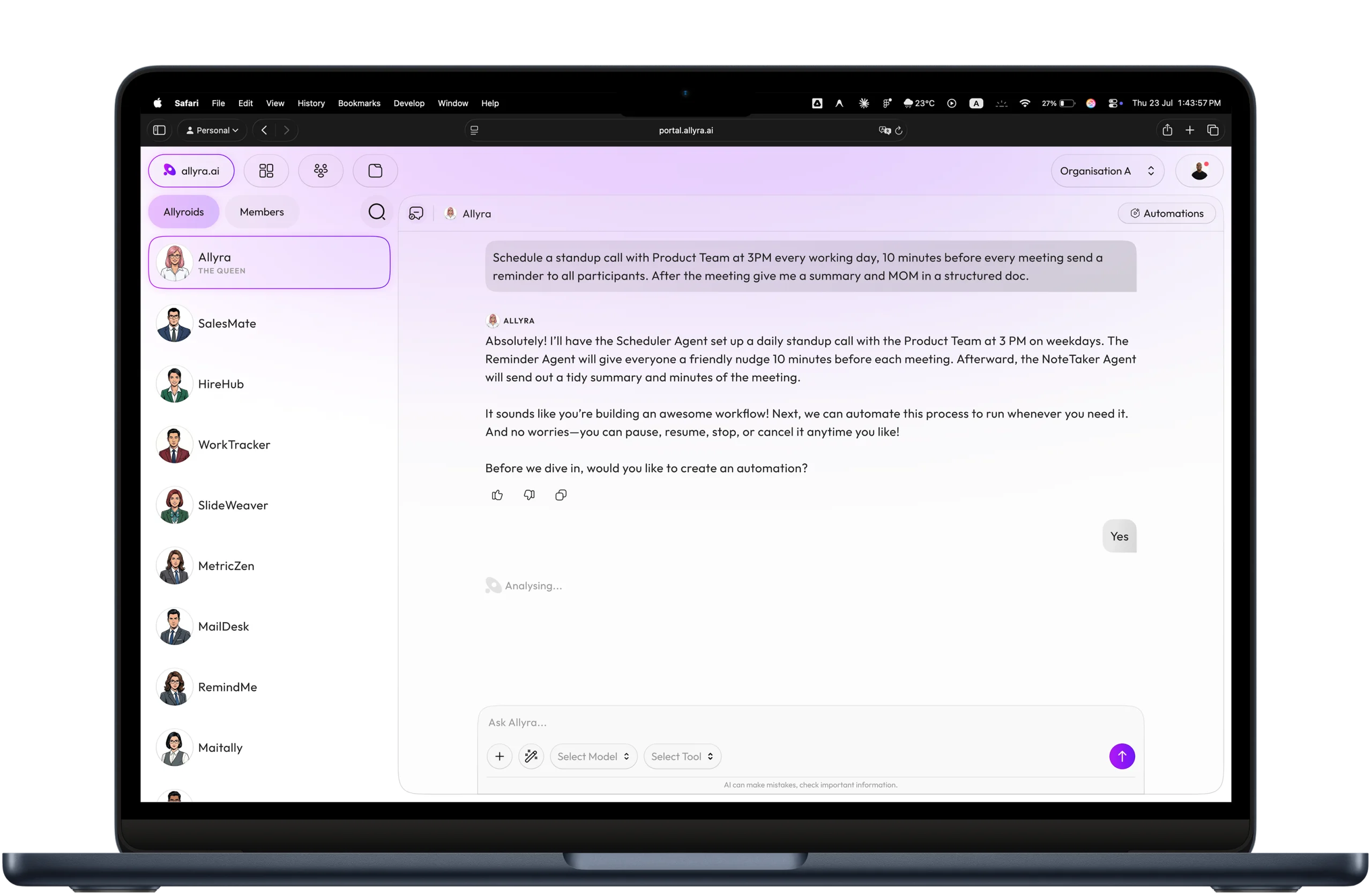
Automation layer: as adoption grew, repetitive operational work moved into automation: scheduling, reminders, meeting summaries and follow-ups. 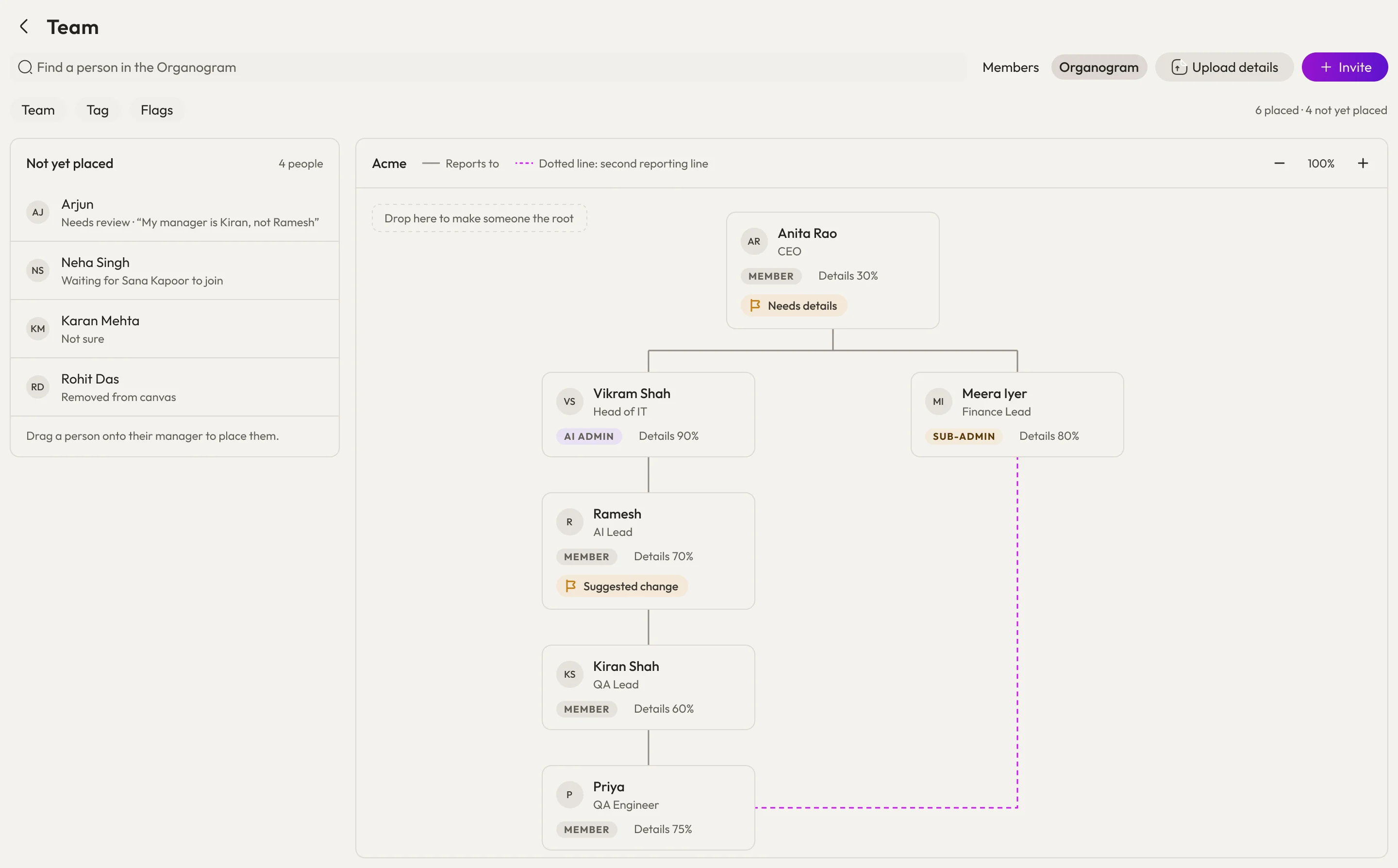
Organisation layer: an editable organogram so agents inherit who reports to whom and who can approve what.
Result
What changed
- 15+organisations onboardedFrom 50+ pilots (~30% converted), including a leading Indian enterprise group; the rest are still in the pipeline
- 1,000+users across those organisationsAs of Jun 2026
- 19+AI agents defined and shippedMarket and customer gaps from the business team, turned into task-focused, human-in-the-loop agent workflows
- 1 → 2–3features per designer / weekTeam of 3 designers + 2 BAs
- 4 → 1workflows in one workspaceResearch to deliverable without handoffs
Trade-offs
What we chose not to do
Control over full automation
In content-heavy workflows like presentations, we kept people in the loop instead of shipping end-to-end automation — quality and accountability mattered more than speed.
Operating layer over more agents
When customers started asking about control, spend and trust, we shifted investment from agent creation to governance and oversight.
What I learned
I started this journey believing the challenge was making AI easier to build. I ended it knowing the challenge is making AI easier to trust.
People don't want AI — they want reliable outcomes. The future isn't autonomous AI; it's well-designed collaboration between people and AI.