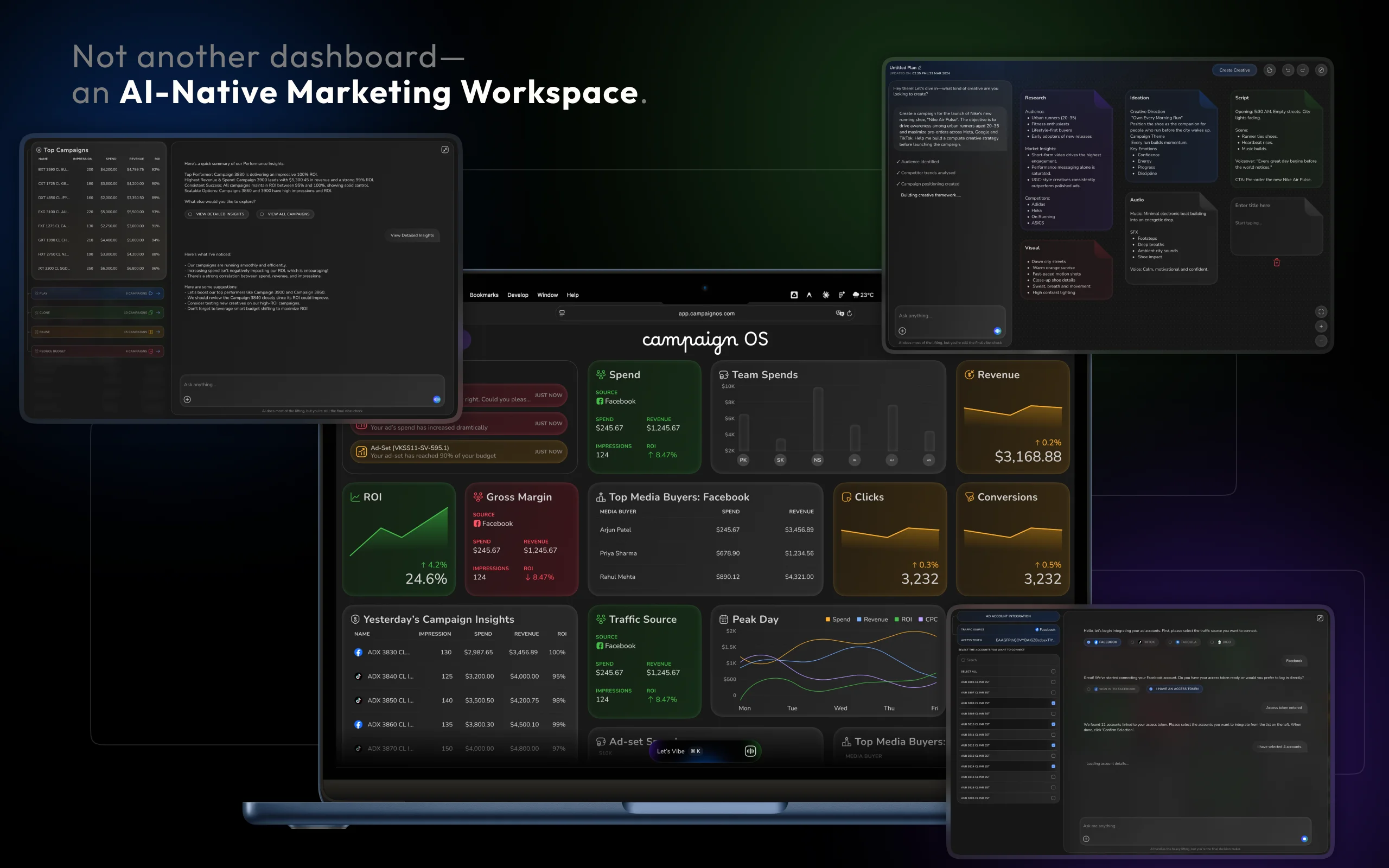
CampaignOS · AI-native marketing platform · 2024 – 25 · Enterprise client pilot · 4 min read
5 campaign stages, one AI workspace: plan, create, launch, monitor and optimise
Designing how AI supports marketers before, during and after a campaign goes live — instead of being one more tool to switch to.
In 60 seconds
- Problem
- Marketing teams rarely struggle with a lack of tools — they struggle with fragmented workflows.
- What I did
- I led the end-to-end product experience for the pilot, designing the workflows that connected campaign planning, AI-assisted creation, performance monitoring and continuous optimisation.
- Result
- Validated in a client pilot by 100+ users with exclusive access
- My role
- UXD Head at Vrozart Dackson
Context
Fragmented tools, not missing ones
Strategy lives in documents, creatives in design tools, campaigns in ad managers and performance in analytics dashboards. AI can generate content, but it rarely understands the complete lifecycle of a campaign.
Instead of asking marketers to learn ever more complex advertising platforms, what if they could focus on outcomes — and let the platform translate business goals into campaign structures, understand marketing context from day one and keep improving performance?
The opportunity wasn't another AI assistant. It was an AI-native workspace where AI is part of the workflow, not an external tool people keep switching to.
My role
What I owned
I led the end-to-end product experience for the pilot, designing the workflows that connected campaign planning, AI-assisted creation, performance monitoring and continuous optimisation.
- Product strategy
- Information architecture
- End-to-end UX
- AI interaction patterns
- Dashboards & analytics
- Campaign planning workflows
- Design-system foundations
- High-fidelity prototypes
The solution
Four ideas that made AI a collaborator
The pilot explored how AI could move beyond content generation to become an active collaborator across the whole campaign lifecycle.
Connected workflows
Planning, execution and optimisation in one continuous experience instead of disconnected marketing tools.
Conversational analytics
Dashboards became contextual conversations that help marketers understand why performance changed, not just what changed.
Living insights
Reusable AI insight blocks that can be explored, remixed and expanded as a campaign evolves.
Calm monitoring
Autonomous monitoring that surfaces only the moments that need a person — validated in the pilot.
Key flow
When AI guides, collaborates, explains — or stays quiet
The core question was what role AI should play at each stage of a campaign. The answer changes as the work moves from planning to optimisation.
- 01
Plan
AI guidesTranslates business goals into campaign structures, with contextual prompt suggestions for strategy.
- 02
Create
AI collaboratesA shared canvas for exploring, remixing and refining AI-generated campaign assets.
- 03
Launch
AI collaboratesMulti-channel deployment with live performance telemetry from the first hour.
- 04
Monitor
AI stays quietWatches continuously and surfaces only meaningful moments for human intervention.
- 05
Optimise
AI explainsConversational analytics turn dashboards into narrative insights the team can act on.
The project's lesson, drawn as a flow: good AI products decide when to lead, when to work alongside people and when to step back.
Craft
Making AI responsive without overwhelming people
Motion, progressive disclosure, contextual side panels and conversational transitions reduce cognitive load while keeping what the AI is doing transparent.
Contextual prompt suggestions guiding campaign strategy and multi-step AI execution. Interactive workspace canvas for exploring, remixing and refining AI campaign assets. Real-time multi-channel deployment with live performance telemetry. Conversational analytics turning complex dashboards into actionable narrative insights. Autonomous monitoring and audience segmentation with human-in-the-loop controls.
What I learned
Designing AI products isn't about adding chat to existing software.
The real challenge is deciding when AI should guide, when it should collaborate and when it should quietly stay out of the way. The best AI experiences adapt to the way people already think, plan and decide.